Doodle of the Day #7

What are thought experiments?
Thought experiments are scenarios of the imagination set up with specific parameters so that different aspects can be explored in a safe and controlled environment. These can be as complicated and scientific as Schrodinger’s Cat, or The Trolley Problem, or just testing of the boundaries of a metaphor such as, “Is a pizza an open faced sandwich?”
Thought experiments give us a chance to play with ideas and a framework to do it in. Thought experiments have a huge overlap with role play, in the therapeutic and the social game sense, both explore the possible outcomes of specific scenarios. In my opinion thought experiments that Scientist and Philosophers seem to do is MORE like role play than the thought experiments writers do, because writers are not then bound to bring their conclusions back to a shared reality.
Scientists and Philosophers are by definition searching for a “Truth”. Writers and artists create knowing it is the observer or reader who brings their truth, or finds their truth in the connection with the piece. They do not need to confine themselves to what is physically, morally, or practically possible. Their limits are the limits of language, the limits of perception, and the limits of imagination. These are very different but overlapping things.
Being able to play with thinking is a very important tool, one I think everyone uses with or without awareness. I am focusing myself to do more thought experimentation and will write up some of what I find to share.
Before I start, I am a big fan of no contact with people who are more invested in controlling you than even knowing you, no less investing in your growth. Abuse is a thing, some behaviors are toxic. Those relationships are not what I am attempting to discuss here. Only YOU can decide where that line is for you.
______________________________________
Can I discuss for a minute the idea that as we as people grow and change, our relationship to our relationships will also change. Just because what used to work for me no longer does, doesn’t mean the relationship is toxic. It doesn’t mean I have to label either myself in the past or the people with whom I need to adjust relationships with as toxic. Let’s just call it different.
I used to need that, whatever it is. Now with time, growth and hopefully healing, I need something else. This can mean needing new boundaries, reframing relationships or even breaking up. This does not mean that anyone needs to be vilified. Human relationships are not zero sum games. They are layered protocols of interactions and attachments. If we as people are growing and changing then the nature of our relationships will need to grow and change as well. You and the people you care about might not be on compatible paths. That is ok. In healthy relationships we realize that everyone’s growth is personal and independent of others. These paths will diverge if people are allowed space and safety to find themselves and their own ways. There are no villains here (at least there don’t have to be.) Just people doing their best to both follow their own paths, support their own journeys and still connect with the people around them. As people heal, they grow and change. These changes mean adjustments to relationships. You will get closer to people going the same direction as you, or are invested in your growth no matter which direction it is. You will feel distance and friction with people who are going different directions and not invested in your growth, if it is not in the same way they are already going. This is a neutral concept. This difference just needs different kinds of boundaries.
Meanwhile I think too often this discussion gets framed in an adversarial model that doesn’t have to be there. There is nothing inherently amoral or bad about having or developing incompatible needs in a relationship. This realization opens up whole worlds of options for establishing new relationships with the people already in our lives.
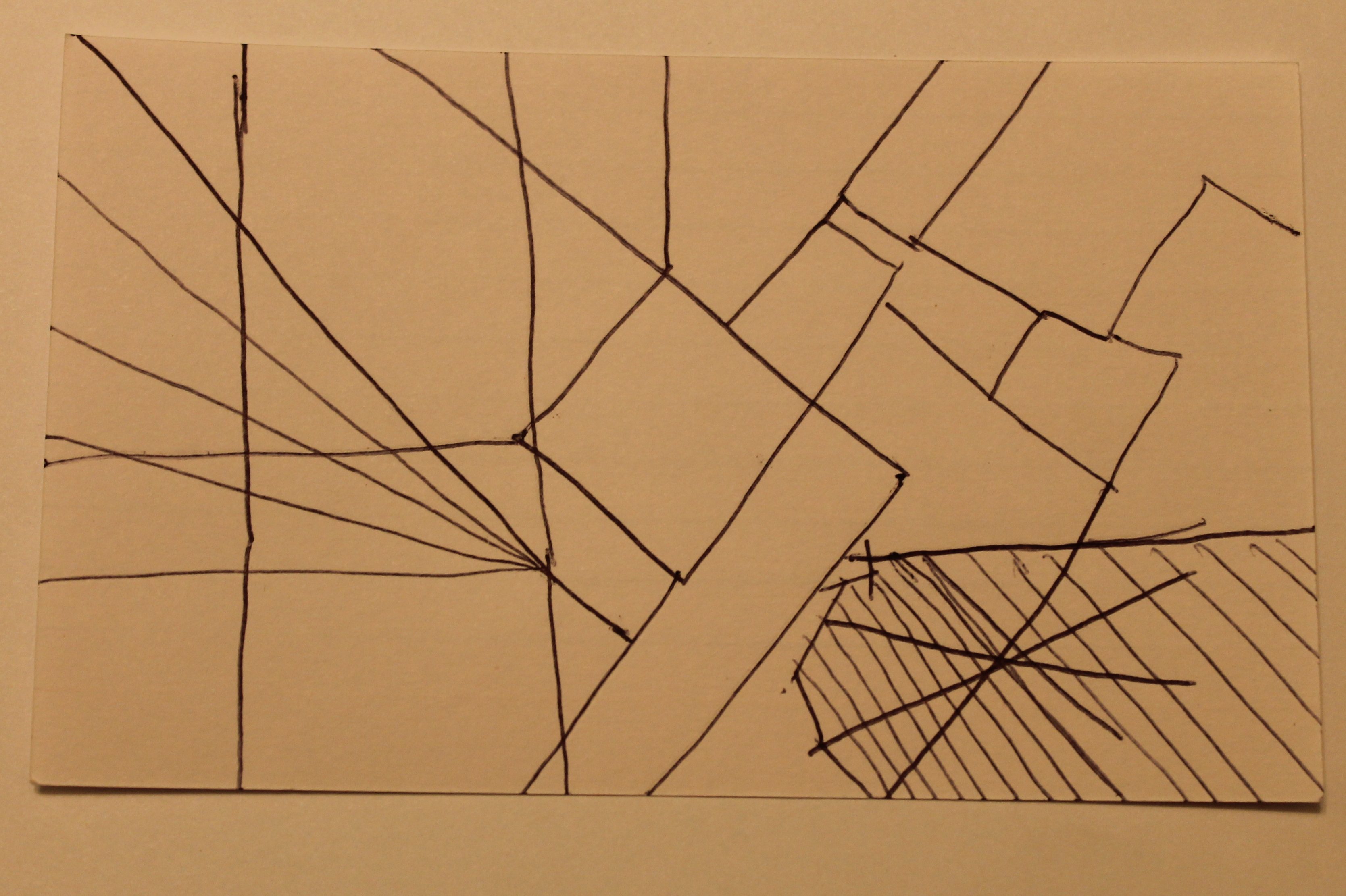
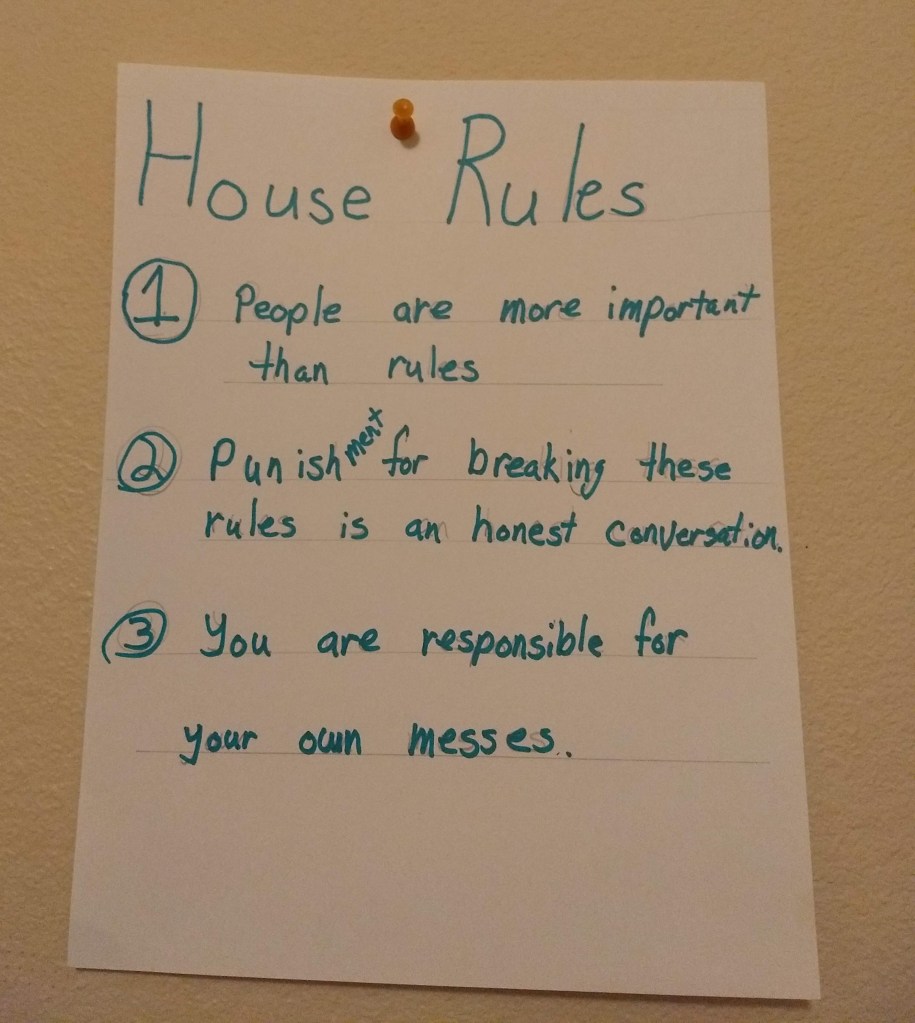
These are my house rules. They look very simple, and they are. I tried to distill the reason for needing rules at all and come up with a formula for how to exist in a shared space. This is what I came up with, three simple rules, but so far they have covered everything that has come up in the years that we have had them at my house.
I want to talk a bit about how they work.
1. People are more important than rules.
I wanted to remember in moments of conflict that the people I live with are important to me. I care about how they are doing and how they are feeling. A person currently having an emotional response to something, will need to experience that first. Conflict cannot be resolved well if we don’t allow for people to have their feelings. (Now how those feelings are expressed may cause messes, see rule 3)
2. The punishment for breaking these rules is an honest conversation.
It might seem funny that this is rule number two. That was deliberate. This rule is the second one, because it sets the expectations for how rules and working together in this space are going to go. If a conflict arises the worst thing that is going to happen, that is not a direct consequence of the issue of the conflict itself, is we have to talk about it. Punishments are by definition additional to the actual consequences of past actions. That is why we have two terms for those concepts. This means there will be no revenge, no getting even, these rules are to help us get along, not to overpower each other.
3. You are responsible for your own messes.
This one seems more simple than it is, too. This refers to the messes we physically make in our space, but also emotional ones in our relationships. This applies to where we harmed each other that pain exists because of a choice that was made. This also does not mean that you cannot ask for help with cleanup. This means that if you are currently not in crisis, sick, etc. that you are responsible for asking someone to do what you cannot. For example: If it’s your day to do the dishes and you don’t have the spoons to make that happen, it is your responsibility to line up someone else to do them for you.
I share these as an example of how you can have “rules” to guide behavior that do not have to be punishment based, they do not have to rely on a hierarchy, they can allow for individuality of self and expression. These work for us but demand that we each invest in cooperation and mutual respect, both for each other and our shared space and responsibilities. I have a small hope that this might inspire someone else. 🙂
Your digital life is a real life, just like people now and in the past have relationships over the phone and before that, via letter. The emotions are real. The connection is real. The impact is REAL. Digital happenings are REAL LIFE. It is detrimental to community to deny that fact. Denial of the reality of what happens digitally allows people the fallacy of thinking they can do whatever they want digitally and it doesn’t matter. Stalking, hate comments, affairs…. this is not an exclusive list. I mean I’m not brainstorming about how to hurt people on the internet that is going to just happen.
I prefer a reframing of the whole idea. I talk about what happens in the digital realm and the physical realm, (I’ve heard some people call the physical realm the Meat Space, ha whatever floats your boat.) Neither is more real nor more important than the other, just different. Every person individually is going to have different relationships with those realms. Some people will be mostly interfacing with their life digitally and some on the other end will never use more than a telephone, no less social media or meme language.
This reframing also makes our methods of communication more neutral. It’s easy to be dismissive of other people if our interactions with them are digital alone, but that is still a real person on the other end. Thinking of the digital realm as just as real as the physical one makes our actions there real, too, because they ARE. This does not make the digital realm superior either, just different.
When you stop holding the digital realm up to the standard of real needing to be physical, you leave space for connection that wasn’t there before. This also means you have to hold yourself to a moral standard that accepts that your actions have impact, both good and bad in both realms. They are both real life. If we take that responsibility seriously, and treat each other with respect, both realms can be safer places to explore and make connections, both enhancing each other.
 Big Thoughts in Our Little World