Zero Sum or Where Tit for Tat Doesn’t Add Up

Today I’m thinking about “Life isn’t a zero sum game.” What does that mean? Well a zero sum game, in game theory, is a game where someone winning also means someone loses. Nothing inherently wrong with that idea and the reality that there are winners and losers whenever there is competition. That’s just the thing life isn’t inherently a competition.

One of the first zero sum games I remember is marbles. In marbles often tradition insists that you “play for keeps”. Meaning the winner gets to take home all the marbles they capture. Their winnings are exactly the opponent’s losses. I hated it. Which probably means I was bad at marbles, and I’m sure I was. How could it be any different? If a bigger kid convinces you to play, they take you for all they can then leave you with fewer resources. Also the high stakes insistence makes practice risky, too.

Approaching life like a game of marbles, leaves us with only seeking to win or avoid loss. This approach leaves people keeping score in their lives. These points and winning often end up damaging our relationships because winning becomes more important than the other person.

When people approach life like a zero sum game everyone is an adversary, trying to get what’s yours while you try to get what’s theirs. There is no room for “ours”. Life becomes a power struggle on every level. That power struggle can be isolating and exhausting.

Shared Reality

If you read my writing or talk to me in person, eventually I will use the words shared reality. I don’t know when I adopted the concept into my understanding of the world but I did. Recently I had someone ask me to clarify what I mean when I say that.

I want to start by talking about individual reality. Because each of us has a unique path through life, we go through secret and mundane unmentionables all the time. Having experiences we don’t share with others gives us an individual perspective on the world. In America, where I live, we are taught as a society that you as an individual matter a whole lot, and while this is true it is just the surface layer of how people navigate the world together. There is also an underlying cultural thread that we are all equal. Together these, and I’m sure many more factors, focus our individual reality with a subtext that our reality is THE Reality.

Once I realized I was doing this, I started thinking of the Shared Reality. First as the places where my experiences overlay other’s experiences. They still aren’t going to match though. As I explored this concept I realized I projected my reality onto other people a lot.

I expanded my thinking and also thought of Shared Reality as the reality that exists outside of individuals. You can talk about this as what could be witnessed by an outsider. The things that exist outside of myself are in the Shared Reality also. If I were wiped from existence, everything that would still be here exists outside myself and is therefore part of another reality that I was sharing. When I disappeared it was still there. This is true for ideas and thoughts not just physical objects or happenings. If an idea or thought is true or represents a truth it will exist whether or not the thinker does, too. (it will also exist if the thinker disagrees.)

I contracted my thinking again, to try to think of practical applications of this concept. First I started observing more. I gave myself space to just let situations and relationships unfold with the life they have on their own. I realized I was limiting the world and my place in it by thinking my reality was the only one. This led to so many possibilities that I never would have thought about on my own. I started being less afraid, I was able to really start adjusting to the idea that Shared Reality might be much better than my individual reality is.

I also started shifting the things I felt responsible for from “everything I could observe or think of” to the things I had personally committed to, or am assigned by a role in life that I have. This one might need an example. If I would witness a stranger approaching a puddle. I would feel obligated to warn them about the puddle, no matter what I was doing, no matter what they were doing. (Imagine someone shouting out their car window at you, etc. “lookout puddle”) I would feel responsible to keep this stranger safe from stepping a little water. Like if I COULD prevent a moment of discomfort for anyone, it was the moral thing to do. Now I try to imagine the shared reality. One where I don’t exist at all. Most of the time in these imaginings, the other person is a capable human and avoids the water on their own. When they don’t, the worst that happens is they get their feet wet. Neither are any of my business.

Don’t get me wrong if I think someone will be hurt, I will say something if I can without making it worse. Meanwhile I have all this extra thought time for myself, living my individual reality, navigating the shared reality with all of you. 🙂

Friction

Today I want to talk about how I reframe interpersonal conflict. At some point I realized that for the most part, people are just people doing their own thing and occasionally that process gets in the way of other people just trying to do their own thing. The places where their paths get in the way of each other I started to call friction.

So now when I find my self upset or emotional at all about someone else’s behavior I look for the friction points. What are they doing exactly? How does that affect what I’m doing or trying to do? How do I feel about that? What do I want now that I have this information? How do I communicate that?

It ends up a tall order BUT it centers my needs for me, before it even considers what the other person is trying to do for themselves. Why would I want that? Well this does a few things:
1. It makes me accountable for discovering my own wants and needs
2. It puts the burden of communicating them on me (diffuses the need for the other person to mind read)
3. It prevents me from projecting the motivations of another person, before I communicate with them.
4. It gives me a chance to both find my needs and support myself.
5. It let’s me find concrete things to ask for or discuss about impact without getting stuck on emotions.
6. It prevents me from accepting the other persons needs as more important than mine as a default.

And these are just the reasons I can think of in this moment.

Now all this is the ideal, not the reality. It’s what I’m trying to do not necessarily what I am able in the moment to do. I am human and I’ve been through a lot. I know my emotions are trying to tell me something, that’s why I’m upset. With my recent growth though, I am understanding that my emotional world is my own. No one else is going to be affected by the world or another person’s actions the same way I will. I have my own unique body, history and experiences. So does everyone else. Our personal experiences are just that PERSONAL. Meaning my emotions, the signals my body gives me to help me understand my experiences, are also personal. They do not translate from one person to another directly. To communicate my needs and wants and have them really be understood, I must do the translation myself.

When I first started this process I found it really unfair. It’s not fair that I have to do all this work when I’m already feeling so hurt, angry or betrayed. Since I have started trying to see conflict as friction, and centering my feelings for myself, it has gotten easier. So much easier. I don’t need others to validate my feelings anymore. (It still feels good when they do, but I accept my feelings whether or not anyone else recognizes them as valid.) I remind myself that if I have my feelings, if I can perceive them, they exist. That is valid.

Ok, so I accepted that my feelings are valid, now what? I have to treat them like they are a top priority. Now it is important to acknowledge here that valid does not mean valid or important to anyone else, these are my feelings and they are important to me. Everyone else has feelings that are as valid and important to them. This shift allows me to care for my feelings and opens up space for the other person to care about theirs.

This internal work lets both people focus on the actual points of friction, without judging each other’s paths, without invalidating each other’s feelings, gives space for both to express their individual needs, because the focus is now on defining and resolving the friction, not on who’s feelings are more important.
Leave the Please

I might just be taking things to literally, but I am not fond of the word “please”. I don’t know if it’s just the formality of it or the implied hierarchy, but I don’t think power dynamics need to be enforced by politeness in that way.

I’m firm believer in respect, but the kind of respect that honors the sovereignty of each of us as equal humans on this planet. There will always be people with more or less power than others, more wealth, more privilege etc., but that doesn’t mean anyone is less worthy of respect and general kindness. In fact I tend to think and act like those with less privilege deserve MORE respect and kindness, with an emphasis on the respect enough to let that person choose what is kind and what is not.

Please as a word, feels like it flies in the face of that respect, and makes you beg for kindness. It leaves a foul taste in my mouth when I say it. When I’m observant I find that often people who insist on the kind of politeness that is emphasized by “please” are the same kind of people who do value and respect power and hierarchy much more than I do. So I am not wary of people who use please, but I am wary of people who insist on it’s use.

I’m not sure when I made the shift, and I suspect it’s when my life shifted to healthier relationships, but I don’t think I ever say please anymore. There are plenty of kind and respectful ways to make requests without it. I don’t miss it at all.

Thank you, on the other hand I say all the time!

Thought Experiments

What are thought experiments?

Thought experiments are scenarios of the imagination set up with specific parameters so that different aspects can be explored in a safe and controlled environment. These can be as complicated and scientific as Schrodinger’s Cat, or The Trolley Problem, or just testing of the boundaries of a metaphor such as, “Is a pizza an open faced sandwich?”

Thought experiments give us a chance to play with ideas and a framework to do it in. Thought experiments have a huge overlap with role play, in the therapeutic and the social game sense, both explore the possible outcomes of specific scenarios. In my opinion thought experiments that Scientist and Philosophers seem to do is MORE like role play than the thought experiments writers do, because writers are not then bound to bring their conclusions back to a shared reality.

Scientists and Philosophers are by definition searching for a “Truth”. Writers and artists create knowing it is the observer or reader who brings their truth, or finds their truth in the connection with the piece. They do not need to confine themselves to what is physically, morally, or practically possible. Their limits are the limits of language, the limits of perception, and the limits of imagination. These are very different but overlapping things.

Being able to play with thinking is a very important tool, one I think everyone uses with or without awareness. I am focusing myself to do more thought experimentation and will write up some of what I find to share.

Needing a Reframing Does Not Mean It Was Toxic

Before I start, I am a big fan of no contact with people who are more invested in controlling you than even knowing you, no less investing in your growth. Abuse is a thing, some behaviors are toxic. Those relationships are not what I am attempting to discuss here. Only YOU can decide where that line is for you.

______________________________________

Can I discuss for a minute the idea that as we as people grow and change, our relationship to our relationships will also change. Just because what used to work for me no longer does, doesn’t mean the relationship is toxic. It doesn’t mean I have to label either myself in the past or the people with whom I need to adjust relationships with as toxic. Let’s just call it different.

I used to need that, whatever it is. Now with time, growth and hopefully healing, I need something else. This can mean needing new boundaries, reframing relationships or even breaking up. This does not mean that anyone needs to be vilified. Human relationships are not zero sum games. They are layered protocols of interactions and attachments. If we as people are growing and changing then the nature of our relationships will need to grow and change as well. You and the people you care about might not be on compatible paths. That is ok. In healthy relationships we realize that everyone’s growth is personal and independent of others. These paths will diverge if people are allowed space and safety to find themselves and their own ways. There are no villains here (at least there don’t have to be.) Just people doing their best to both follow their own paths, support their own journeys and still connect with the people around them. As people heal, they grow and change. These changes mean adjustments to relationships. You will get closer to people going the same direction as you, or are invested in your growth no matter which direction it is. You will feel distance and friction with people who are going different directions and not invested in your growth, if it is not in the same way they are already going. This is a neutral concept. This difference just needs different kinds of boundaries.

Meanwhile I think too often this discussion gets framed in an adversarial model that doesn’t have to be there. There is nothing inherently amoral or bad about having or developing incompatible needs in a relationship. This realization opens up whole worlds of options for establishing new relationships with the people already in our lives.

House Rules

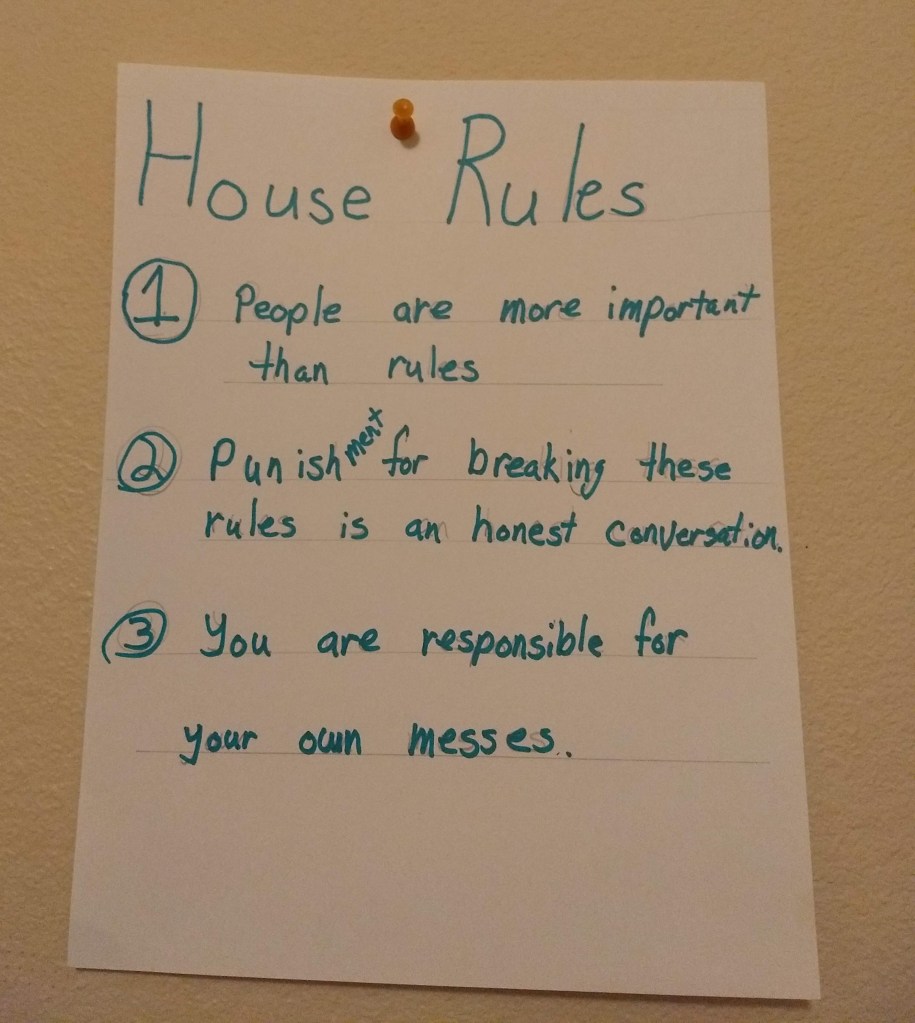
Handwritten sign saying:
House Rules
1.People are more important than rules
2.The punishment for breaking these rules is an honest conversation.
3. You are responsible for your own messes.
The Rules in my house.

These are my house rules. They look very simple, and they are. I tried to distill the reason for needing rules at all and come up with a formula for how to exist in a shared space. This is what I came up with, three simple rules, but so far they have covered everything that has come up in the years that we have had them at my house.

I want to talk a bit about how they work.

1. People are more important than rules.

I wanted to remember in moments of conflict that the people I live with are important to me. I care about how they are doing and how they are feeling. A person currently having an emotional response to something, will need to experience that first. Conflict cannot be resolved well if we don’t allow for people to have their feelings. (Now how those feelings are expressed may cause messes, see rule 3)

2. The punishment for breaking these rules is an honest conversation.

It might seem funny that this is rule number two. That was deliberate. This rule is the second one, because it sets the expectations for how rules and working together in this space are going to go. If a conflict arises the worst thing that is going to happen, that is not a direct consequence of the issue of the conflict itself, is we have to talk about it. Punishments are by definition additional to the actual consequences of past actions. That is why we have two terms for those concepts. This means there will be no revenge, no getting even, these rules are to help us get along, not to overpower each other.

3. You are responsible for your own messes.

This one seems more simple than it is, too. This refers to the messes we physically make in our space, but also emotional ones in our relationships. This applies to where we harmed each other that pain exists because of a choice that was made. This also does not mean that you cannot ask for help with cleanup. This means that if you are currently not in crisis, sick, etc. that you are responsible for asking someone to do what you cannot. For example: If it’s your day to do the dishes and you don’t have the spoons to make that happen, it is your responsibility to line up someone else to do them for you.

I share these as an example of how you can have “rules” to guide behavior that do not have to be punishment based, they do not have to rely on a hierarchy, they can allow for individuality of self and expression. These work for us but demand that we each invest in cooperation and mutual respect, both for each other and our shared space and responsibilities. I have a small hope that this might inspire someone else. 🙂