“That’s alright I’m used to it.”

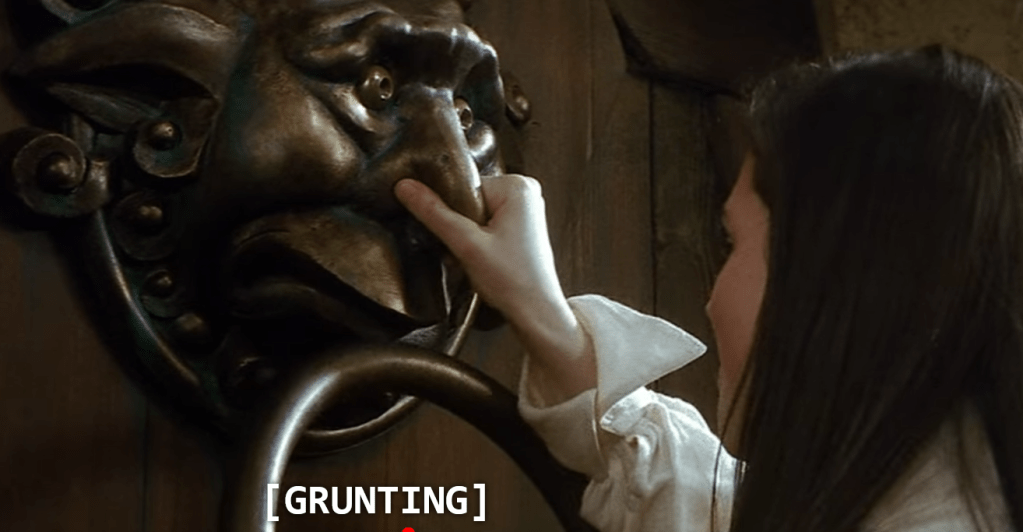
Screen capture from the movie "Labrynth" depicting Sarah holding the nose of a living brass doorknocker, with the sound capture [Grunting} showing.
Just accept the status quo.

This scene. I keep coming back to this scene from 1986 “Labyrinth”.
Sarah is racing against the clock. Time is of the essence. She must find her brother. Things are very urgent to her. She comes to a place where her path is blocked by two doors with living knockers. She has to solve a logic puzzle to choose which door to open. That puzzle doesn’t stick with me. What does is how she proceeds.

The knocker she chooses realizes they like their freedom from having to hold and talk around the knocker ring in their mouth. They resist actively having it put back in. The other knocker even comments that they, “Can’t blame ’em.” But Sarah has her quest and chooses to basically suffocate the chosen knocker by holding their nose and forcing the mouth open so she can reinsert the ring. She doesn’t look comfortable doing it, but knows she’s justified. The knocker’s mouth opens. She reinserts the ring and knocks.

The door opens and Sarah scoots past with a quick, “Sorry.” Which the knocker then replies, “That’s alright I’m used to it. ” Sarah resumes her quest and the movie moves on.

My thoughts stay though. How many, many places in my life do I settle into, “That’s ok, I’m used to it?” Is it ok though? Am I signing up/volunteering/stepping up to/fixing things, just because I always have? Or because I should somehow? Do I really have to settle this way? Do I want to?

Now often when I feel myself sigh with frustration at being stuck in a task I do not enjoy, thinking the whole time, I’m the one who does this. The line from the movie floats through my head, “That’s alright I’m used to it.” and I realize it’s not. It wasn’t right for the knocker and it’s not right for me.

So I start digging, asking myself questions, as I do. What isn’t working? Why do I do this at all? Do I have to be the one to do it? Why? Usually somewhere in this questioning I find that I just fell into a routine and did it unthinkingly and that became a standard, both for me and others around me.

I am thinking of this in terms of household and work tasks. They tend to fall on certain people. Asking for a change is brave. It is not easy to do, because it’s never just about the task. It’s about the relationship. Will this change how I’m seen in ways I can’t control. Right now I’m seen as the person who happily (or begrudgingly) does this particular thing. What will fill this void? How will this change affect my reputation as a worker or partner. I think this is really where the fear lies, not in the delegation of the tasks, but the possible damage to the relationship.

If I try to change this will I be seen as disagreeable? lazy? selfish? Sometimes. But this is probably a red flag in that relationship. Even if that is the case I know it’s better to work on changing things because it is no longer working out for me. I am the only one who can assess my needs and feelings, I have to advocate for myself.

When I do advocate for myself I get three typical responses, immediate acceptance and action, disinterest/brush off, or immediate rejection. Sometimes these are knee-jerk reactions, but even those fall pretty much in these categories. All of these options are better than saying or risking nothing. Why? Because I no longer accept suffering in silence. If they accept the change, yay! If they do nothing, or reject, they cannot do either of those things without knowledge it was brought to their attention. Self advocation brings awareness of your situation into the shared reality. Even if nothing else changes, that did. Now if the status quo does not change and still causes me suffering, I am not suffering because I didn’t say anything, I am suffering because something else needs to change.

With this knowledge I make much better informed choices. I can choose to settle back into what I’m used to, even though it’s not working for me. I can try again for change within the relationship, or I can leave the relationship. Each of these options has innumerable variants. I can start working on easing my suffering one way or another. Advocacy is empowerment. Once I state my grievance or concern and I get the reaction I get, these things are no longer guesswork. I don’t have to guess how the reaction to the proposal will be, I know. I can look for patterns and choose what I want for me.

Unfortunately most of the times I have had to do this, I also had to end the relationship. The status quo was valued more than I was. The thing is, that was true before I tested it. That’s why I was afraid in the first place. Testing it did not create that dynamic, it proved it. Once I prove something like that to myself I can’t go back to being so unvalued, while consciously aware that I’m unvalued. I might be used to it, but that doesn’t make it alright.

Shared Reality

If you read my writing or talk to me in person, eventually I will use the words shared reality. I don’t know when I adopted the concept into my understanding of the world but I did. Recently I had someone ask me to clarify what I mean when I say that.

I want to start by talking about individual reality. Because each of us has a unique path through life, we go through secret and mundane unmentionables all the time. Having experiences we don’t share with others gives us an individual perspective on the world. In America, where I live, we are taught as a society that you as an individual matter a whole lot, and while this is true it is just the surface layer of how people navigate the world together. There is also an underlying cultural thread that we are all equal. Together these, and I’m sure many more factors, focus our individual reality with a subtext that our reality is THE Reality.

Once I realized I was doing this, I started thinking of the Shared Reality. First as the places where my experiences overlay other’s experiences. They still aren’t going to match though. As I explored this concept I realized I projected my reality onto other people a lot.

I expanded my thinking and also thought of Shared Reality as the reality that exists outside of individuals. You can talk about this as what could be witnessed by an outsider. The things that exist outside of myself are in the Shared Reality also. If I were wiped from existence, everything that would still be here exists outside myself and is therefore part of another reality that I was sharing. When I disappeared it was still there. This is true for ideas and thoughts not just physical objects or happenings. If an idea or thought is true or represents a truth it will exist whether or not the thinker does, too. (it will also exist if the thinker disagrees.)

I contracted my thinking again, to try to think of practical applications of this concept. First I started observing more. I gave myself space to just let situations and relationships unfold with the life they have on their own. I realized I was limiting the world and my place in it by thinking my reality was the only one. This led to so many possibilities that I never would have thought about on my own. I started being less afraid, I was able to really start adjusting to the idea that Shared Reality might be much better than my individual reality is.

I also started shifting the things I felt responsible for from “everything I could observe or think of” to the things I had personally committed to, or am assigned by a role in life that I have. This one might need an example. If I would witness a stranger approaching a puddle. I would feel obligated to warn them about the puddle, no matter what I was doing, no matter what they were doing. (Imagine someone shouting out their car window at you, etc. “lookout puddle”) I would feel responsible to keep this stranger safe from stepping a little water. Like if I COULD prevent a moment of discomfort for anyone, it was the moral thing to do. Now I try to imagine the shared reality. One where I don’t exist at all. Most of the time in these imaginings, the other person is a capable human and avoids the water on their own. When they don’t, the worst that happens is they get their feet wet. Neither are any of my business.

Don’t get me wrong if I think someone will be hurt, I will say something if I can without making it worse. Meanwhile I have all this extra thought time for myself, living my individual reality, navigating the shared reality with all of you. 🙂

Leave the Please

I might just be taking things to literally, but I am not fond of the word “please”. I don’t know if it’s just the formality of it or the implied hierarchy, but I don’t think power dynamics need to be enforced by politeness in that way.

I’m firm believer in respect, but the kind of respect that honors the sovereignty of each of us as equal humans on this planet. There will always be people with more or less power than others, more wealth, more privilege etc., but that doesn’t mean anyone is less worthy of respect and general kindness. In fact I tend to think and act like those with less privilege deserve MORE respect and kindness, with an emphasis on the respect enough to let that person choose what is kind and what is not.

Please as a word, feels like it flies in the face of that respect, and makes you beg for kindness. It leaves a foul taste in my mouth when I say it. When I’m observant I find that often people who insist on the kind of politeness that is emphasized by “please” are the same kind of people who do value and respect power and hierarchy much more than I do. So I am not wary of people who use please, but I am wary of people who insist on it’s use.

I’m not sure when I made the shift, and I suspect it’s when my life shifted to healthier relationships, but I don’t think I ever say please anymore. There are plenty of kind and respectful ways to make requests without it. I don’t miss it at all.

Thank you, on the other hand I say all the time!

Digital v. Physical

Your digital life is a real life, just like people now and in the past have relationships over the phone and before that, via letter. The emotions are real. The connection is real. The impact is REAL. Digital happenings are REAL LIFE. It is detrimental to community to deny that fact. Denial of the reality of what happens digitally allows people the fallacy of thinking they can do whatever they want digitally and it doesn’t matter. Stalking, hate comments, affairs…. this is not an exclusive list. I mean I’m not brainstorming about how to hurt people on the internet that is going to just happen.

I prefer a reframing of the whole idea. I talk about what happens in the digital realm and the physical realm, (I’ve heard some people call the physical realm the Meat Space, ha whatever floats your boat.) Neither is more real nor more important than the other, just different. Every person individually is going to have different relationships with those realms. Some people will be mostly interfacing with their life digitally and some on the other end will never use more than a telephone, no less social media or meme language.

This reframing also makes our methods of communication more neutral. It’s easy to be dismissive of other people if our interactions with them are digital alone, but that is still a real person on the other end. Thinking of the digital realm as just as real as the physical one makes our actions there real, too, because they ARE. This does not make the digital realm superior either, just different.

When you stop holding the digital realm up to the standard of real needing to be physical, you leave space for connection that wasn’t there before. This also means you have to hold yourself to a moral standard that accepts that your actions have impact, both good and bad in both realms. They are both real life. If we take that responsibility seriously, and treat each other with respect, both realms can be safer places to explore and make connections, both enhancing each other.