You say I’m spineless. I agree. I am an octopus. I can fill in all the cracks. Make you smooth if I want to
I can change my shape, change my appearance at will. I can be what I need to be. I am agile and flexible. Curious and adventurous. I am strong. I am fast. I am gentle or ruthless at my choosing.
I keep my own counsel. If I’m here I want to be here. I can distract you in a flash and be gone.
You see my cunning as deceit, but I am just me, All the shapes of me. My core is the same no matter what shape I appear. You meant it as an insult.
Spineless
It is not. It is just a different way of being. You can look into my alien eyes and think I’m so different.
With lovely horrified nostalgia, I miss your terracotta shop.
The digital process using absurd language for situations, lead to fantastical thought experiments that turn the stomach and remain gleeful just the same.
What??!??
“As I create a trap for villagers, that usually releases them….before they drown. Wait for them to get hungry so I can lure them into the tiny shop so they can’t escape.”
Digital situation applied to human affect Morals leave questions of extension of empathy.
Do avatars feel pain? Or boredom? or Desire? And it is just a game.
Still… Even in its most extrapolated imagining, elicits an emotional empathetic response.
Still the slave labor underground vault of colorful blocks was beautiful.
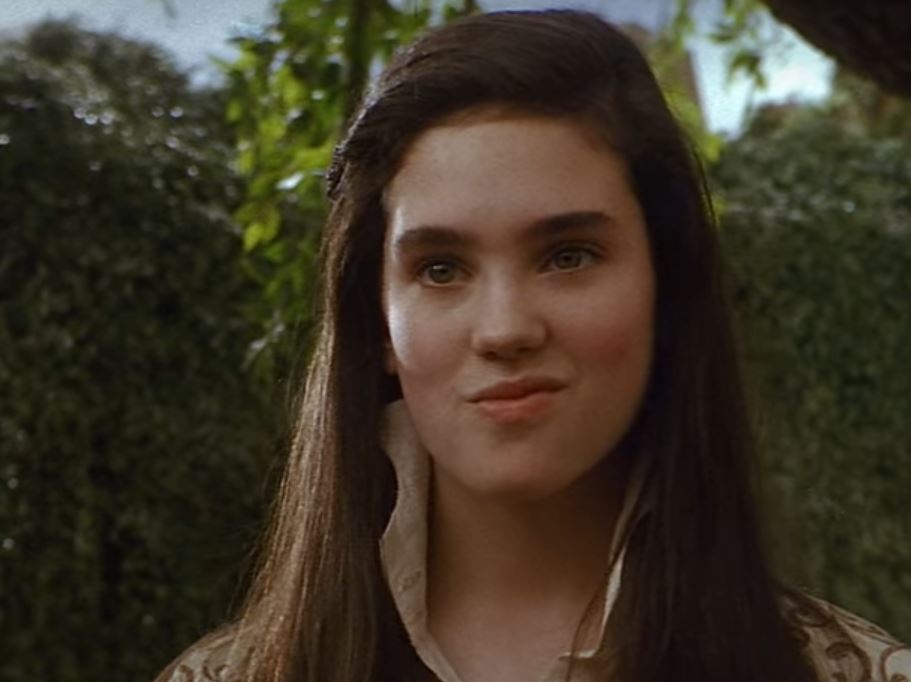
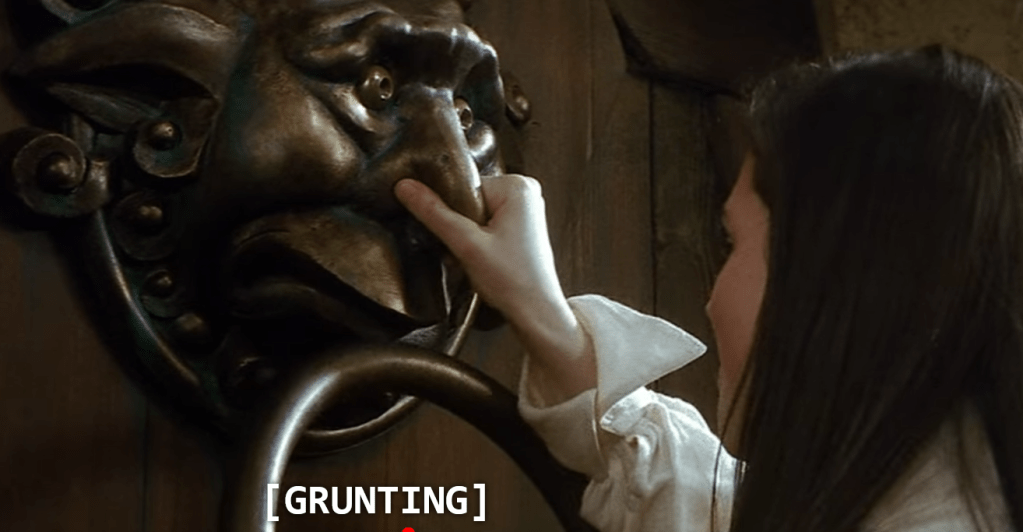
I wrote my first post about this scene on how I was inspired to rethink my position on accepting things just because they are familiar. This is on how when rewatching this scene, Sarah doesn’t seem to think this is wrong, like I thought she did. Look at this face. In no way do I think she’s being evil. She looks like she is enjoying her discovery of a clever solution, which is exactly what is happening in this scene.
Seeing it now and knowing what comes next makes me uncomfortable. (She holds a door knocker’s nose to suffocate them until they open their mouth for her.) Yes, this is completely overthinking the plight of a fictional fantasy door knocker in a movie with puppets. At the same time, when have I had this kind of impact? How many times have I been so determined, so set on my goals that I didn’t even notice the distress I caused others around me.
It can be so easy to justify what would be in any other context terrible behavior, when we are faced with dire circumstances. Sarah has a limited amount of time to save her brother from The Goblin King. I doubt that she would under normal circumstances just jump to the conclusion that a logical course of action would include depriving a stranger of air to get what she wanted. Her urgent mission kind of short circuits reason and gives a pass on what is acceptable behavior.
This is not the face of regret.
Sarah goes from thinking of her solution to action within seconds. She doesn’t stop to think if that is the best decision or her only solution. There may have been many other ways to solve her problem of being able to use the knocker on the door. She could have asked the knocker of the best solution from their point of view, and maybe her choice would have still been the one she had to use, but she went there first.
It can be so easy to get caught up in what we are doing that we don’t notice that it’s not fun and games for everyone in our wake. These last few years have been hard on almost everyone. It can be easy to lose sight of the impact of our actions as we navigate hard circumstance in the strange new territory of our technological world.
The longer the stressful circumstances remain, with life thrown off kilter dealing with social unrest and a global pandemic in it’s third year, the more I and my fellow humans on this rock in space may have gotten comfortable with behavior I would not be proud of in other circumstances. I’m taking this time to reflect and assess. I want to make choices based on being proud of myself in the future, not just finding the most clever way to get by.
I want to state that I love the movie, Labyrinth. This scene, and the fact that I can pick it apart and learn things about myself, speaks to the richness of the source material. The fact that Sarah is absolutely a fallible character, that she is not perfect and makes odd choices, makes this a fun and engaging story.
I’m grateful for the reminder that if I check in with myself and am honest, I get the opportunity to choose the impact I have. I won’t have to look back on my life and see places where I got used to things I really wish I hadn’t, and get to be the person I chose to be, rather than who I was swept up to become. It is very easy to get swept up in things and end up places you didn’t mean to go. I’ve done enough of that, I want to choose more wisely now.
You never get a second chance to make a first impression.
That is how the saying goes, but I actually learn a lot more from my second impression. That is where I really determine how I feel.
For example, in a first interaction with a random stranger, I expect we are both on not necessarily our best behavior, but at least “reasonable in public” behavior, and I will err on the side of kindness. If you treat me badly I will not change how I treat you, necessarily but I will remember how you treated me.
What is really telling to me is how our next interaction goes, does this now recognizable stranger behave the same way? If so I will have better boundaries now that I know what to expect. But if they treat me better I will add that to my knowledge of them and act accordingly knowing they exhibit both behaviors. I won’t forget I was treated badly, but I won’t carry the expectation that I have to defend myself against this person.
Best of all, is if they acknowledge that it went badly the first time… I probably won’t want to stay strangers. This is the good stuff where friendships are made. The level of introspection and vulnerability it takes to bring up our own unpleasant behavior, is a good sign to me that this person is safe to do that with also. I know that impression might be wrong, but in these cases it’s worth the risk to find out.
So for me that second impression, where an incident or meeting becomes a pattern, is the really important point one. I don’t expect people to be perfect, but I appreciate when someone goes to the effort to acknowledge a bad first impression. That second one will be the one that sticks.
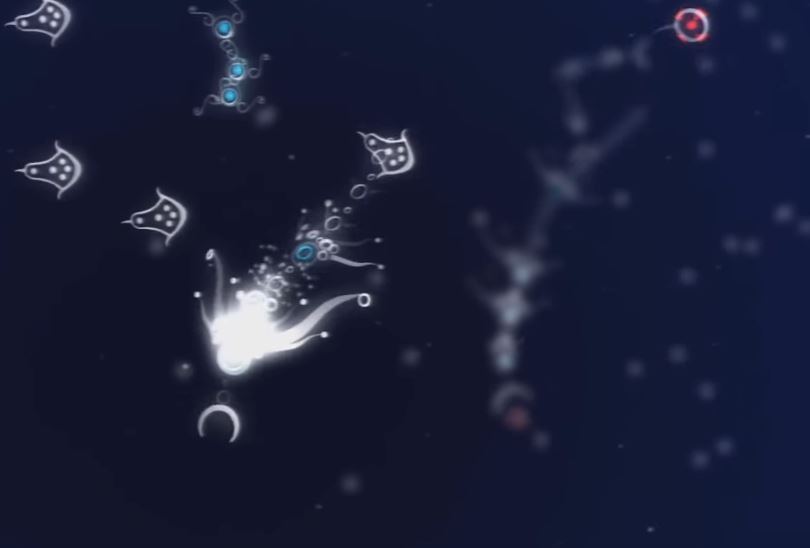
FlOw is a video game where you play as basically a microscopic water creature. Info about the game and it’s history here. It is a game, an art piece, and an experience.
Beautiful game in visuals and sound. Note: the creature in the background is on another level.
You move through your two dimensional playing area as a microscopic water creature. You eat and defend yourself and grow and evolve. The mechanic that really changed the way I relate to my thinking though, was the change in dimension. The level up. There is a spot in each level where if you touch it you will jump dimensions in scope and scale. (You will hang out with bigger or smaller creatures.) The game will still show the other levels very subtly in the fore and background.
Years after playing this game I found myself thinking about how our lives have different dimensions, and the concerns and details of each don’t necessarily overlap, so you aren’t always aware of how each effects the life as a whole. Visualizing changing the scope and scale of my observance, like the mechanic of this game really helped me find my own tools for checking in with my big picture.
I started realizing I concern myself a lot with things that just don’t matter on other scales, both too large and too small. For example, the checker at the grocery store doesn’t need to know anything about my thought experiments on the concept of self, nor my opinions the differences in the seasons of The Witcher. In the now of buying my groceries we gotta keep it simple and in the most common language. Though they may also be Witcher fans.
I just use small talk as a neutral example. I use this concept of adjusting scope and scale when I am caught in a feeling also. If I feel stuck, I try to adjust the scope and scale of my thinking. How long are the effects of whatever is bothering me going to last? Which parts of my life are affected? I can make choices without putting a hierarchy on facts over feelings. I find ways to deal with facts including my feelings. I can look out for myself and my goals, by adjusting my scope and scale.
In getting to a better understanding of the shared reality, the closer and also the more distant you look the more you can’t really define anything in life via a binary.
What about good and bad? Well first of all most things are neutral or meh. Most things are just fun or functional or useful or not. The lines between them are often labeled as a moral division, but usually upon closer inspection they are a cultural distinction or just an opinion. Very few things in life really cross the line to where they need a moral distinction, and those distinctions are going to vary based on those exact cultural influences.
What about night and day? That seems pretty binary, right? That doesn’t take into account twilight. Or leaving Earth entirely. Once you are in space the notion of night and day is one that no longer has to apply to you. So even night and day are less of a binary than they seem. Hmmm.
I was raised in a Christian society where things were explained to me as right or wrong. Everything went into one box or the other and as I grew and changed my thinking some things would move from one box to the other. Now I am trying to change my thinking again to remove the boxes entirely, unravel the binaries where I find them. Usually while I do this I find that the binaries only pointed out differences that didn’t matter to me anyway. They were arbitrary at best and hurtful at worst. I don’t need them anymore.
I embrace meh instead. Meh is the idea that most things in life just are. Most people in life are just doing their thing, they don’t have an agenda, they are not trying to change the world. Some are of course, but most are not. It’s not a morality thing at all. It is ok to just live your life.
I do not deny that there is real good and evil in the world. Contrary to what my cultural upbringing taught me most things do not fall into those categories, I don’t need to search for the right thing to do, or look for the evil in things I don’t like. Most of the time there is no right thing to do, just options, and most times my dislikes are a matter of opinion. Applying morality is inappropriate.
As I have started this work on myself, I have so much less stress. My feelings run away from me less. I spend less time defensive, less time judgemental. I create a safer space for my own odd existence. I also found counterintuitively, that I have more space for doing good, validating the effects of evil so I can stop contributing to it, and just peace. Once I stopped looking for a judgement that wasn’t there I got to use my personal judgement to decide where I want to put my support and energy, and where I wanted to draw my boundaries. Meh has been more peaceful than I imagined life could be.
This scene. I keep coming back to this scene from 1986 “Labyrinth”. Sarah is racing against the clock. Time is of the essence. She must find her brother. Things are very urgent to her. She comes to a place where her path is blocked by two doors with living knockers. She has to solve a logic puzzle to choose which door to open. That puzzle doesn’t stick with me. What does is how she proceeds.
The knocker she chooses realizes they like their freedom from having to hold and talk around the knocker ring in their mouth. They resist actively having it put back in. The other knocker even comments that they, “Can’t blame ’em.” But Sarah has her quest and chooses to basically suffocate the chosen knocker by holding their nose and forcing the mouth open so she can reinsert the ring. She doesn’t look comfortable doing it, but knows she’s justified. The knocker’s mouth opens. She reinserts the ring and knocks.
The door opens and Sarah scoots past with a quick, “Sorry.” Which the knocker then replies, “That’s alright I’m used to it. ” Sarah resumes her quest and the movie moves on.
My thoughts stay though. How many, many places in my life do I settle into, “That’s ok, I’m used to it?” Is it ok though? Am I signing up/volunteering/stepping up to/fixing things, just because I always have? Or because I should somehow? Do I really have to settle this way? Do I want to?
Now often when I feel myself sigh with frustration at being stuck in a task I do not enjoy, thinking the whole time, I’m the one who does this. The line from the movie floats through my head, “That’s alright I’m used to it.” and I realize it’s not. It wasn’t right for the knocker and it’s not right for me.
So I start digging, asking myself questions, as I do. What isn’t working? Why do I do this at all? Do I have to be the one to do it? Why? Usually somewhere in this questioning I find that I just fell into a routine and did it unthinkingly and that became a standard, both for me and others around me.
I am thinking of this in terms of household and work tasks. They tend to fall on certain people. Asking for a change is brave. It is not easy to do, because it’s never just about the task. It’s about the relationship. Will this change how I’m seen in ways I can’t control. Right now I’m seen as the person who happily (or begrudgingly) does this particular thing. What will fill this void? How will this change affect my reputation as a worker or partner. I think this is really where the fear lies, not in the delegation of the tasks, but the possible damage to the relationship.
If I try to change this will I be seen as disagreeable? lazy? selfish? Sometimes. But this is probably a red flag in that relationship. Even if that is the case I know it’s better to work on changing things because it is no longer working out for me. I am the only one who can assess my needs and feelings, I have to advocate for myself.
When I do advocate for myself I get three typical responses, immediate acceptance and action, disinterest/brush off, or immediate rejection. Sometimes these are knee-jerk reactions, but even those fall pretty much in these categories. All of these options are better than saying or risking nothing. Why? Because I no longer accept suffering in silence. If they accept the change, yay! If they do nothing, or reject, they cannot do either of those things without knowledge it was brought to their attention. Self advocation brings awareness of your situation into the shared reality. Even if nothing else changes, that did. Now if the status quo does not change and still causes me suffering, I am not suffering because I didn’t say anything, I am suffering because something else needs to change.
With this knowledge I make much better informed choices. I can choose to settle back into what I’m used to, even though it’s not working for me. I can try again for change within the relationship, or I can leave the relationship. Each of these options has innumerable variants. I can start working on easing my suffering one way or another. Advocacy is empowerment. Once I state my grievance or concern and I get the reaction I get, these things are no longer guesswork. I don’t have to guess how the reaction to the proposal will be, I know. I can look for patterns and choose what I want for me.
Unfortunately most of the times I have had to do this, I also had to end the relationship. The status quo was valued more than I was. The thing is, that was true before I tested it. That’s why I was afraid in the first place. Testing it did not create that dynamic, it proved it. Once I prove something like that to myself I can’t go back to being so unvalued, while consciously aware that I’m unvalued. I might be used to it, but that doesn’t make it alright.
I was doing research for another article I want to write to post here, and I fell down a rabbit hole and it won’t be ready for a while. In the mean time I was reminded that what we call a “Normal Life” right now is something that has never existed before.
Human beings instantly being able to talk to each other, anywhere on the planet? Sharing ideas, supporting each other, flinging insults… the whole thing! This has never been done before. There is no way to know if we are doing it right or wrong. I don’t think you CAN do it right or wrong, and then I remember the insults thing. Yeah there is a lot we can do better.
I just wanted to take the time to just remind myself and anyone who reads this, that we are in uncharted territory. The results of what we do now will have lots of unintended consequences. This isn’t to scare myself or anyone else into stagnation, no it is to validate the gravity of that fact. To cut myself a little slack when I feel daunted getting up in the morning and not knowing if I as a person am up to navigating the ENTIRE UNIVERSE AT MY INSTANT FINGERTIPS. It is daunting and the reality is that what I do in that shared digital space has consequences that unlike the physical reality, they do not decay with time.
Our brains and instincts are set up to help us navigate a mammalian animal life. That life exists in a physical realm where change is unavoidable and absolutely necessary, stagnation is death and decay, (which is also change). We cannot escape it, but there is a comfort in that also. We can accept our note in the song our place in the cycle of things.
As we trailblaze into this new universe we created for ourselves, everything we do is visible and stays. It is a strange new relationship with responsibility, a call to be more genuine. A gentle reminder that what we create ends up having a life of its own outside any expectations of what it would be. This will be good and bad, but mostly it will just be.
So it’s ok to be daunted by the enormity of the face of everything at once, and we are all doing it the best we can. None of us have ever done it before, we can’t look to history to see what its impacts will be. We have to watch them unfold even though we won’t have perspective to see the real patterns. We are in the thick of it right now, way too close to what’s happening to see anything at all.
So I choose, every day to try to be clearer and kind. If I’m going to send ripples out into this new universe, I don’t want them to be ones that I’m ashamed of. I want to create places I want to come back and visit. When I remember this time of my life (Its the internet none of this is going anywhere). I may look back and think I was pretentious and naive, but hopefully also kind. That’s the trail I want to blaze.
“Do unto others as you would have them do onto you.”
That was the golden rule as it was taught to me. I thought it was the real definitive way to know how to treat other people. I would literally treat other people the way I wanted them to treat me, basically teach them how to treat me by treating them the same way.
There is just one problem with that. Other people aren’t me. They are their own whole other person, with thoughts, needs, feelings, history, culture and the list goes on and on. How I want to be treated has no bearing on how other people want to be treated. By living the golden rule literally, I mostly became annoying.
Really the take away from how we treat other people is how we think it is acceptable to act. What I mean when I say that is if you are a disher of harsh criticism, it sets the scene for others to think that harsh criticism is how you interact with the world so criticizing you harshly is acceptable. This may or may not be the criticizer’s preference, but now it is out there anyway.
So instead of the simplistic golden rule, I think of it this way: Treat others the way THEY want to be treated, AND behave the way I want others to behave around me. I like being treated with respect. I know that every person feels respected in different ways. I try to follow their lead and listen when they tell me I’m off.
 Big Thoughts in Our Little World