You want to know why I’m so isolated? I was told at a young age I was out of control. I needed to be put in a cage.
So I built myself one. I don’t know how I justified it Whether I thought I was protecting everyone from me or me from everyone. I suspect there is fluctuation between these points.
None wanted to come into my cage, and no one invited me into theirs. And since I didn’t even know it was there I bumped into it all the time. It made me sad and mad. I blamed myself my worth my abilities my frustration my lack of self control often due to my frustration my mental illness my trauma
My cage that I was instructed to build made me into a paranoid creature Trolls in her brain
When you are punished randomly and fiercely When any effort to demand your worth or feelings is also punished swiftly When the feelings and thoughts of strangers is more important than your own, You receive instructions In code for cage construction. Now I’m dedicated to doing what I think I’m supposed to do.
People who love me couldn’t reach me in there.
I gave some people I deemed worthy the key. Encouraged them to open the door. I still wouldn’t come out.
Now I do, but it’s hard to move, hard to know what to do when no longer confined. The overwhelm is so powerful.
No one ever says thank you. The job is just done. The done, the doing become identity. The job is just done.
Unless it doesn’t. Then comes the blame, the shame, the friction and more. It hasn’t been done. No one is doing it. Like clockwork or tides or seasons, it has always taken care of itself. But it hasn’t, it was always me, but no one noticed.
Oh they notice, now. Not to step up or support. They notice to complain, to give advice, to fix to insist you fix yourself. You must be broke if you can no longer perform. The magic stopped. You didn’t ask why.
The things piled up, nothing got done. You didn’t ask why. The space that used to emanate light and music went dark and silent. How long did it take to notice?
And I know it’s not enough, never enough. Utility might pay Capitalism but it’s never enough for a heart. Hearts need different magic. Equal magic not servant magic. Partner magic not prisoner magic. They feel the same at introduction but they are not. In time the dissonance is deafening and the servant becomes invisible, Only the utility remains.
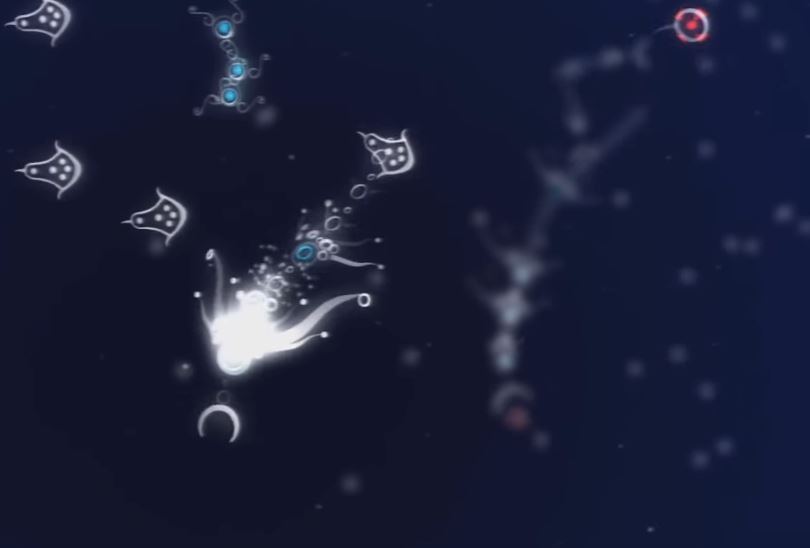
FlOw is a video game where you play as basically a microscopic water creature. Info about the game and it’s history here. It is a game, an art piece, and an experience.
Beautiful game in visuals and sound. Note: the creature in the background is on another level.
You move through your two dimensional playing area as a microscopic water creature. You eat and defend yourself and grow and evolve. The mechanic that really changed the way I relate to my thinking though, was the change in dimension. The level up. There is a spot in each level where if you touch it you will jump dimensions in scope and scale. (You will hang out with bigger or smaller creatures.) The game will still show the other levels very subtly in the fore and background.
Years after playing this game I found myself thinking about how our lives have different dimensions, and the concerns and details of each don’t necessarily overlap, so you aren’t always aware of how each effects the life as a whole. Visualizing changing the scope and scale of my observance, like the mechanic of this game really helped me find my own tools for checking in with my big picture.
I started realizing I concern myself a lot with things that just don’t matter on other scales, both too large and too small. For example, the checker at the grocery store doesn’t need to know anything about my thought experiments on the concept of self, nor my opinions the differences in the seasons of The Witcher. In the now of buying my groceries we gotta keep it simple and in the most common language. Though they may also be Witcher fans.
I just use small talk as a neutral example. I use this concept of adjusting scope and scale when I am caught in a feeling also. If I feel stuck, I try to adjust the scope and scale of my thinking. How long are the effects of whatever is bothering me going to last? Which parts of my life are affected? I can make choices without putting a hierarchy on facts over feelings. I find ways to deal with facts including my feelings. I can look out for myself and my goals, by adjusting my scope and scale.
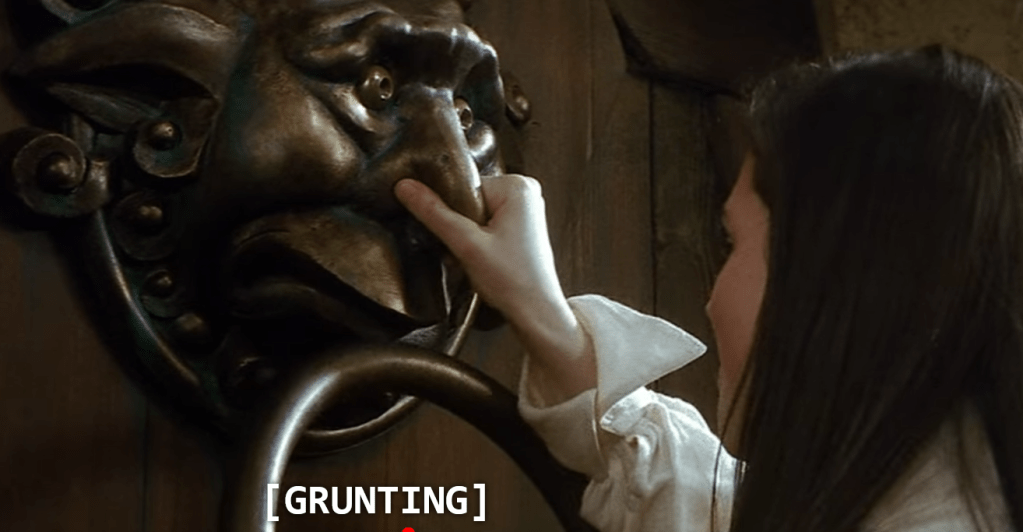
This scene. I keep coming back to this scene from 1986 “Labyrinth”. Sarah is racing against the clock. Time is of the essence. She must find her brother. Things are very urgent to her. She comes to a place where her path is blocked by two doors with living knockers. She has to solve a logic puzzle to choose which door to open. That puzzle doesn’t stick with me. What does is how she proceeds.
The knocker she chooses realizes they like their freedom from having to hold and talk around the knocker ring in their mouth. They resist actively having it put back in. The other knocker even comments that they, “Can’t blame ’em.” But Sarah has her quest and chooses to basically suffocate the chosen knocker by holding their nose and forcing the mouth open so she can reinsert the ring. She doesn’t look comfortable doing it, but knows she’s justified. The knocker’s mouth opens. She reinserts the ring and knocks.
The door opens and Sarah scoots past with a quick, “Sorry.” Which the knocker then replies, “That’s alright I’m used to it. ” Sarah resumes her quest and the movie moves on.
My thoughts stay though. How many, many places in my life do I settle into, “That’s ok, I’m used to it?” Is it ok though? Am I signing up/volunteering/stepping up to/fixing things, just because I always have? Or because I should somehow? Do I really have to settle this way? Do I want to?
Now often when I feel myself sigh with frustration at being stuck in a task I do not enjoy, thinking the whole time, I’m the one who does this. The line from the movie floats through my head, “That’s alright I’m used to it.” and I realize it’s not. It wasn’t right for the knocker and it’s not right for me.
So I start digging, asking myself questions, as I do. What isn’t working? Why do I do this at all? Do I have to be the one to do it? Why? Usually somewhere in this questioning I find that I just fell into a routine and did it unthinkingly and that became a standard, both for me and others around me.
I am thinking of this in terms of household and work tasks. They tend to fall on certain people. Asking for a change is brave. It is not easy to do, because it’s never just about the task. It’s about the relationship. Will this change how I’m seen in ways I can’t control. Right now I’m seen as the person who happily (or begrudgingly) does this particular thing. What will fill this void? How will this change affect my reputation as a worker or partner. I think this is really where the fear lies, not in the delegation of the tasks, but the possible damage to the relationship.
If I try to change this will I be seen as disagreeable? lazy? selfish? Sometimes. But this is probably a red flag in that relationship. Even if that is the case I know it’s better to work on changing things because it is no longer working out for me. I am the only one who can assess my needs and feelings, I have to advocate for myself.
When I do advocate for myself I get three typical responses, immediate acceptance and action, disinterest/brush off, or immediate rejection. Sometimes these are knee-jerk reactions, but even those fall pretty much in these categories. All of these options are better than saying or risking nothing. Why? Because I no longer accept suffering in silence. If they accept the change, yay! If they do nothing, or reject, they cannot do either of those things without knowledge it was brought to their attention. Self advocation brings awareness of your situation into the shared reality. Even if nothing else changes, that did. Now if the status quo does not change and still causes me suffering, I am not suffering because I didn’t say anything, I am suffering because something else needs to change.
With this knowledge I make much better informed choices. I can choose to settle back into what I’m used to, even though it’s not working for me. I can try again for change within the relationship, or I can leave the relationship. Each of these options has innumerable variants. I can start working on easing my suffering one way or another. Advocacy is empowerment. Once I state my grievance or concern and I get the reaction I get, these things are no longer guesswork. I don’t have to guess how the reaction to the proposal will be, I know. I can look for patterns and choose what I want for me.
Unfortunately most of the times I have had to do this, I also had to end the relationship. The status quo was valued more than I was. The thing is, that was true before I tested it. That’s why I was afraid in the first place. Testing it did not create that dynamic, it proved it. Once I prove something like that to myself I can’t go back to being so unvalued, while consciously aware that I’m unvalued. I might be used to it, but that doesn’t make it alright.
So I spend way too much of my time on TikTok, and one of the gems I have found is a creator called Domesic Blisters. She (KC Davis) also has a book and website, but I haven’t read the book.
Davis really gets nitty gritty about how to let yourself be not ok and still take care of yourself, your space and your family. Starting with the thing that got me hooked: “Care tasks are morally neutral, they are functional not moral”. While I was already on a path that was leading me to this very conclusion, those specific words have been a game changer.
The idea that your struggle does not make you a bad person, and that evidence of your struggle doesn’t either, is a wonderful weapon I use to fight shame messages in my thinking. If my house is messy but I can still find the things I need, then it is functional, there is no need for blame or shame around the mess.
By removing the layer of judgement inherit in seeing daily care tasks as moral rather than just functional, Davis, creates mental space to really look at enhancing functionality, and embracing individual strategies for arranging your life and space. She shows her audience the ways she does things that work for her and her particular struggles. She encourages us all to find the strategies that work with our personal tendencies and the life you have right now.
This ends up looking like storing things where they tend to end up anyway, or having collection baskets in those places. Even bagging up garbage to throw in the garbage if you can’t get to it right away or throwing away the dishes if necessary!! Your house, routines and stuff should serve you and support you and your life not the other way around.
If you like me sometimes have emotional reactions to daily care tasks, I absolutely encourage you to check out Domestic Blisters. If only to see how easily and thoughtfully she handles trolls. 🙂
This week I want to acknowledge all of the things that this book series opened my awareness to. Kushiel’s Legacy (the first trilogy), is an amazing fantasy novel series from the early 2000s by Jaqueline Carey. You can find more about her and them at: https://www.jacquelinecarey.com/kushiels-legacy-trilogies/
I will be vague about the details of the story and world building, both of which are excellent and very complicated. They center on a fantasy version of a pre-industrial France, with a complicated monarchy and polytheistic religion, including a goddess of sex work, Namaah. The story centers around a young woman born into service of this goddess, then thrust by circumstances and fate (or gods) into a life of intrigue.
Oh My! These books introduced me to concepts about consent, kink, legacies, parenting, fostering, international politics, polyamory, war, succession and so much more. It also put all of this into a world where every single one of these things is sacred.
It changed the way I look at love, my body, politics, desire, relationships, marriage, religion, duty, maybe everything. Not that these books are a bible or a text to live you life by, no not at all, but they did open my eyes and expand my imagination as to how things could be. Knowing that things could be different changed my life.
I am rereading Kushiel’s Chosen right now, and while I have a different perspective on many things, I am grateful for the things I have learned from this series. I have grown a lot since I fell in love with Phedre, so glad her story opened so many doors for me.
All information exists and is understood through context. The sources we root our ideas in have an impact on the directions of our conversations and the meanings behind them. If we do not discuss them they become subtext and invisible. While it is not essential to eliminate all subtext from communication, it is valuable to discuss our sources from time to time.
This (hopefully weekly) feature of BTiOLW, will give me a chance to share my sources, and inspirations, also known in some internet circles as “The Sauce”, giving relative context to the topics discussed and lead to better nuance and mutual understanding.
The first “Sauce” I would like to feature is the work of Brene Brown, especially the book, Daring Greatly. Which I do not remember specifics about but have absorbed a lot of the ideas presented in her work and was inspired by, Daring Greatly, in particular to start this blog and be more vulnerable and out there. I just rewatched her TED talk, “The Power of Vulnerability“. It was just as powerful as the last time I watched it. She has such an authenticity of spirit, that is essential to encouraging others to be introspective about their lives.
Meanwhile I am taking the advice and not making a perfect post. I’m making a good enough post. Her work and ideas have an influence on the way I think and write, I am acknowledging that here, both in gratitude and for context into the future.



 Big Thoughts in Our Little World