Bridging the gap between what must be done and what is known requires a leap of faith. Belief in the Oracles while trusting that oracles have an impractical point of view. Their worlds are vague and myopic. They see what they see but they don’t always know how to talk about it.
They live life outside events so they can observe them. Those that move through the world feel differently about it than that. Oracles speak to us in a language that makes perfect sense to them, but is unanchored in a doer’s experience. Miscommunication is inevitable.
Oracles speak the truth, but it is their truth alone. Wisdom and action lie in the overlap of their world and ours. This calculation is not for everyone. The prophesy may not be for you.
And what a lonely life to be the observer of ages. Knower of patterns Suggester of paths Clear vision requires distance, patience. Oracles can never be in the thick of things.
Life must pass them by.
Point of view held apart by its very nature. Solitude a necessity of the role.
Remember that when you make the arduous climb to their outpost when you think about scoffing at an offering at their feet when you complain that the prophesy makes no sense when you remind them, often to their face, that the visit there was a waste of time
They hold themselves apart so they can see what you cannot. A thankless job A lonely task A sacred trust and vocation
It is their job to observe and speak their truth. Making sense of your own perspective, That’s your own job.
With lovely horrified nostalgia, I miss your terracotta shop.
The digital process using absurd language for situations, lead to fantastical thought experiments that turn the stomach and remain gleeful just the same.
What??!??
“As I create a trap for villagers, that usually releases them….before they drown. Wait for them to get hungry so I can lure them into the tiny shop so they can’t escape.”
Digital situation applied to human affect Morals leave questions of extension of empathy.
Do avatars feel pain? Or boredom? or Desire? And it is just a game.
Still… Even in its most extrapolated imagining, elicits an emotional empathetic response.
Still the slave labor underground vault of colorful blocks was beautiful.
You want to know why I’m so isolated? I was told at a young age I was out of control. I needed to be put in a cage.
So I built myself one. I don’t know how I justified it Whether I thought I was protecting everyone from me or me from everyone. I suspect there is fluctuation between these points.
None wanted to come into my cage, and no one invited me into theirs. And since I didn’t even know it was there I bumped into it all the time. It made me sad and mad. I blamed myself my worth my abilities my frustration my lack of self control often due to my frustration my mental illness my trauma
My cage that I was instructed to build made me into a paranoid creature Trolls in her brain
When you are punished randomly and fiercely When any effort to demand your worth or feelings is also punished swiftly When the feelings and thoughts of strangers is more important than your own, You receive instructions In code for cage construction. Now I’m dedicated to doing what I think I’m supposed to do.
People who love me couldn’t reach me in there.
I gave some people I deemed worthy the key. Encouraged them to open the door. I still wouldn’t come out.
Now I do, but it’s hard to move, hard to know what to do when no longer confined. The overwhelm is so powerful.
No one ever says thank you. The job is just done. The done, the doing become identity. The job is just done.
Unless it doesn’t. Then comes the blame, the shame, the friction and more. It hasn’t been done. No one is doing it. Like clockwork or tides or seasons, it has always taken care of itself. But it hasn’t, it was always me, but no one noticed.
Oh they notice, now. Not to step up or support. They notice to complain, to give advice, to fix to insist you fix yourself. You must be broke if you can no longer perform. The magic stopped. You didn’t ask why.
The things piled up, nothing got done. You didn’t ask why. The space that used to emanate light and music went dark and silent. How long did it take to notice?
And I know it’s not enough, never enough. Utility might pay Capitalism but it’s never enough for a heart. Hearts need different magic. Equal magic not servant magic. Partner magic not prisoner magic. They feel the same at introduction but they are not. In time the dissonance is deafening and the servant becomes invisible, Only the utility remains.
You never get a second chance to make a first impression.
That is how the saying goes, but I actually learn a lot more from my second impression. That is where I really determine how I feel.
For example, in a first interaction with a random stranger, I expect we are both on not necessarily our best behavior, but at least “reasonable in public” behavior, and I will err on the side of kindness. If you treat me badly I will not change how I treat you, necessarily but I will remember how you treated me.
What is really telling to me is how our next interaction goes, does this now recognizable stranger behave the same way? If so I will have better boundaries now that I know what to expect. But if they treat me better I will add that to my knowledge of them and act accordingly knowing they exhibit both behaviors. I won’t forget I was treated badly, but I won’t carry the expectation that I have to defend myself against this person.
Best of all, is if they acknowledge that it went badly the first time… I probably won’t want to stay strangers. This is the good stuff where friendships are made. The level of introspection and vulnerability it takes to bring up our own unpleasant behavior, is a good sign to me that this person is safe to do that with also. I know that impression might be wrong, but in these cases it’s worth the risk to find out.
So for me that second impression, where an incident or meeting becomes a pattern, is the really important point one. I don’t expect people to be perfect, but I appreciate when someone goes to the effort to acknowledge a bad first impression. That second one will be the one that sticks.
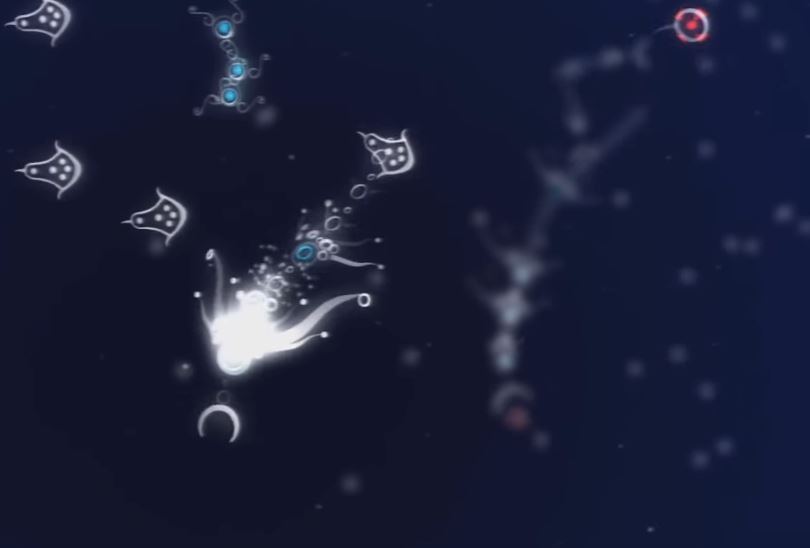
FlOw is a video game where you play as basically a microscopic water creature. Info about the game and it’s history here. It is a game, an art piece, and an experience.
Beautiful game in visuals and sound. Note: the creature in the background is on another level.
You move through your two dimensional playing area as a microscopic water creature. You eat and defend yourself and grow and evolve. The mechanic that really changed the way I relate to my thinking though, was the change in dimension. The level up. There is a spot in each level where if you touch it you will jump dimensions in scope and scale. (You will hang out with bigger or smaller creatures.) The game will still show the other levels very subtly in the fore and background.
Years after playing this game I found myself thinking about how our lives have different dimensions, and the concerns and details of each don’t necessarily overlap, so you aren’t always aware of how each effects the life as a whole. Visualizing changing the scope and scale of my observance, like the mechanic of this game really helped me find my own tools for checking in with my big picture.
I started realizing I concern myself a lot with things that just don’t matter on other scales, both too large and too small. For example, the checker at the grocery store doesn’t need to know anything about my thought experiments on the concept of self, nor my opinions the differences in the seasons of The Witcher. In the now of buying my groceries we gotta keep it simple and in the most common language. Though they may also be Witcher fans.
I just use small talk as a neutral example. I use this concept of adjusting scope and scale when I am caught in a feeling also. If I feel stuck, I try to adjust the scope and scale of my thinking. How long are the effects of whatever is bothering me going to last? Which parts of my life are affected? I can make choices without putting a hierarchy on facts over feelings. I find ways to deal with facts including my feelings. I can look out for myself and my goals, by adjusting my scope and scale.
In getting to a better understanding of the shared reality, the closer and also the more distant you look the more you can’t really define anything in life via a binary.
What about good and bad? Well first of all most things are neutral or meh. Most things are just fun or functional or useful or not. The lines between them are often labeled as a moral division, but usually upon closer inspection they are a cultural distinction or just an opinion. Very few things in life really cross the line to where they need a moral distinction, and those distinctions are going to vary based on those exact cultural influences.
What about night and day? That seems pretty binary, right? That doesn’t take into account twilight. Or leaving Earth entirely. Once you are in space the notion of night and day is one that no longer has to apply to you. So even night and day are less of a binary than they seem. Hmmm.
I was raised in a Christian society where things were explained to me as right or wrong. Everything went into one box or the other and as I grew and changed my thinking some things would move from one box to the other. Now I am trying to change my thinking again to remove the boxes entirely, unravel the binaries where I find them. Usually while I do this I find that the binaries only pointed out differences that didn’t matter to me anyway. They were arbitrary at best and hurtful at worst. I don’t need them anymore.
I embrace meh instead. Meh is the idea that most things in life just are. Most people in life are just doing their thing, they don’t have an agenda, they are not trying to change the world. Some are of course, but most are not. It’s not a morality thing at all. It is ok to just live your life.
I do not deny that there is real good and evil in the world. Contrary to what my cultural upbringing taught me most things do not fall into those categories, I don’t need to search for the right thing to do, or look for the evil in things I don’t like. Most of the time there is no right thing to do, just options, and most times my dislikes are a matter of opinion. Applying morality is inappropriate.
As I have started this work on myself, I have so much less stress. My feelings run away from me less. I spend less time defensive, less time judgemental. I create a safer space for my own odd existence. I also found counterintuitively, that I have more space for doing good, validating the effects of evil so I can stop contributing to it, and just peace. Once I stopped looking for a judgement that wasn’t there I got to use my personal judgement to decide where I want to put my support and energy, and where I wanted to draw my boundaries. Meh has been more peaceful than I imagined life could be.
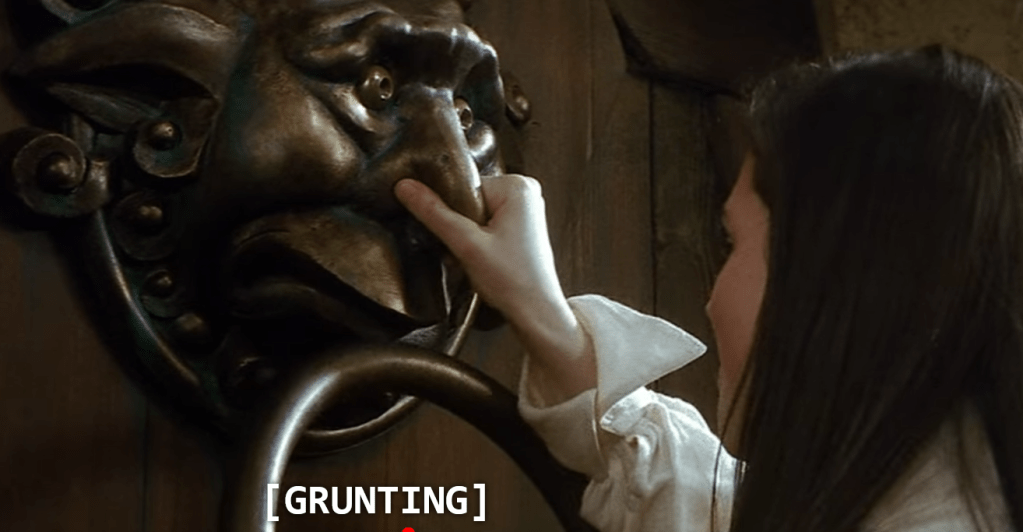
This scene. I keep coming back to this scene from 1986 “Labyrinth”. Sarah is racing against the clock. Time is of the essence. She must find her brother. Things are very urgent to her. She comes to a place where her path is blocked by two doors with living knockers. She has to solve a logic puzzle to choose which door to open. That puzzle doesn’t stick with me. What does is how she proceeds.
The knocker she chooses realizes they like their freedom from having to hold and talk around the knocker ring in their mouth. They resist actively having it put back in. The other knocker even comments that they, “Can’t blame ’em.” But Sarah has her quest and chooses to basically suffocate the chosen knocker by holding their nose and forcing the mouth open so she can reinsert the ring. She doesn’t look comfortable doing it, but knows she’s justified. The knocker’s mouth opens. She reinserts the ring and knocks.
The door opens and Sarah scoots past with a quick, “Sorry.” Which the knocker then replies, “That’s alright I’m used to it. ” Sarah resumes her quest and the movie moves on.
My thoughts stay though. How many, many places in my life do I settle into, “That’s ok, I’m used to it?” Is it ok though? Am I signing up/volunteering/stepping up to/fixing things, just because I always have? Or because I should somehow? Do I really have to settle this way? Do I want to?
Now often when I feel myself sigh with frustration at being stuck in a task I do not enjoy, thinking the whole time, I’m the one who does this. The line from the movie floats through my head, “That’s alright I’m used to it.” and I realize it’s not. It wasn’t right for the knocker and it’s not right for me.
So I start digging, asking myself questions, as I do. What isn’t working? Why do I do this at all? Do I have to be the one to do it? Why? Usually somewhere in this questioning I find that I just fell into a routine and did it unthinkingly and that became a standard, both for me and others around me.
I am thinking of this in terms of household and work tasks. They tend to fall on certain people. Asking for a change is brave. It is not easy to do, because it’s never just about the task. It’s about the relationship. Will this change how I’m seen in ways I can’t control. Right now I’m seen as the person who happily (or begrudgingly) does this particular thing. What will fill this void? How will this change affect my reputation as a worker or partner. I think this is really where the fear lies, not in the delegation of the tasks, but the possible damage to the relationship.
If I try to change this will I be seen as disagreeable? lazy? selfish? Sometimes. But this is probably a red flag in that relationship. Even if that is the case I know it’s better to work on changing things because it is no longer working out for me. I am the only one who can assess my needs and feelings, I have to advocate for myself.
When I do advocate for myself I get three typical responses, immediate acceptance and action, disinterest/brush off, or immediate rejection. Sometimes these are knee-jerk reactions, but even those fall pretty much in these categories. All of these options are better than saying or risking nothing. Why? Because I no longer accept suffering in silence. If they accept the change, yay! If they do nothing, or reject, they cannot do either of those things without knowledge it was brought to their attention. Self advocation brings awareness of your situation into the shared reality. Even if nothing else changes, that did. Now if the status quo does not change and still causes me suffering, I am not suffering because I didn’t say anything, I am suffering because something else needs to change.
With this knowledge I make much better informed choices. I can choose to settle back into what I’m used to, even though it’s not working for me. I can try again for change within the relationship, or I can leave the relationship. Each of these options has innumerable variants. I can start working on easing my suffering one way or another. Advocacy is empowerment. Once I state my grievance or concern and I get the reaction I get, these things are no longer guesswork. I don’t have to guess how the reaction to the proposal will be, I know. I can look for patterns and choose what I want for me.
Unfortunately most of the times I have had to do this, I also had to end the relationship. The status quo was valued more than I was. The thing is, that was true before I tested it. That’s why I was afraid in the first place. Testing it did not create that dynamic, it proved it. Once I prove something like that to myself I can’t go back to being so unvalued, while consciously aware that I’m unvalued. I might be used to it, but that doesn’t make it alright.
 Big Thoughts in Our Little World